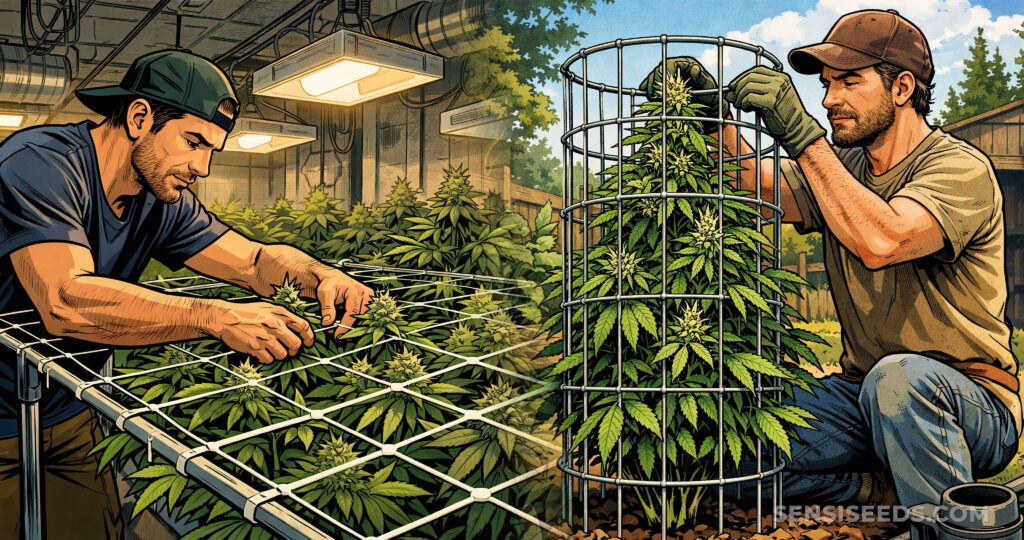
The Romans sure knew what they were doing when they began using trellises to grow vines and grapes. Now, you too can harness the power of cannabis trellises to grow bigger, healthier, and higher-yielding plants.
Table of contents
Trellising is an age-old gardening practice; so old, in fact, that even the Romans used it to boost the yields of their crops. But trellises aren’t limited to growing tomatoes, peas, beans, or gourds; they can be just as effective in improving the yields of cannabis.
In this article, we’ll teach you all there is to know about cannabis trellises. Of course, we’ll walk you through the basics of setting up a trellis or netting for your cannabis plants, both indoors and outside.
Moreover, we’ll also compare vertical and horizontal trellising with ScrOG, explain the key benefits of growing with a cannabis trellis, and explore the importance of cannabis plant support in general.
What is a cannabis trellis?
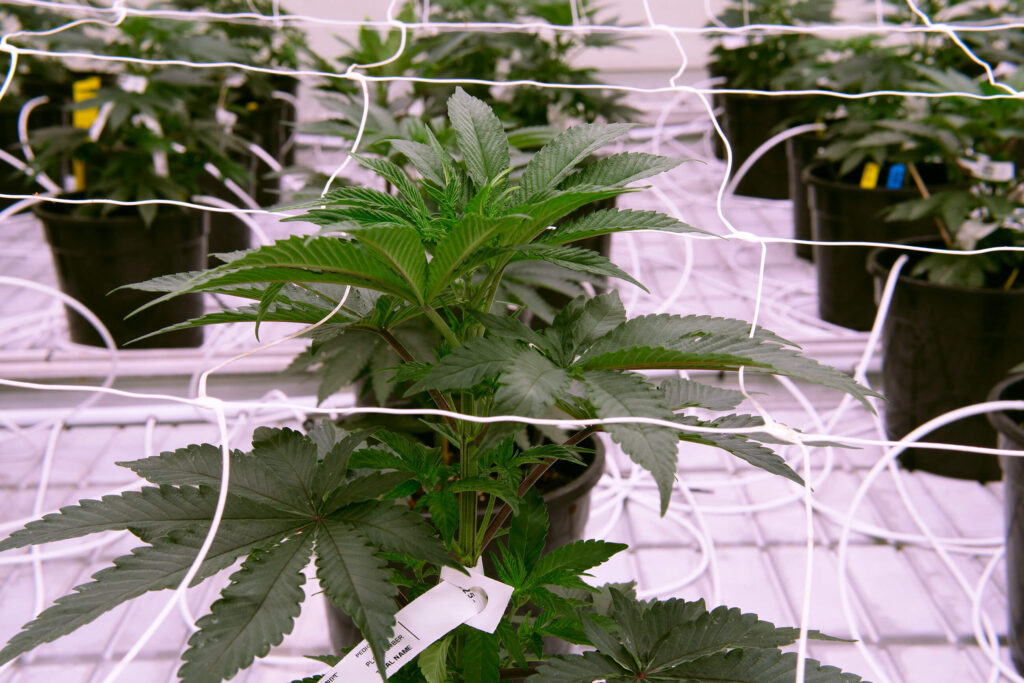
A cannabis trellis is a physical structure used to simultaneously provide plant support and direct the growth of cannabis plants. Most commonly, the trellises you see in use in cannabis gardens are made out of netting, mesh, or metal, but they can also be made out of string, PVC pipes, or wood.
In essence, cannabis trellises or support nets play two simple, yet very important roles that can greatly improve both the quality and size of a harvest. During veg, trellises can be used to shape the structure and architecture of a plant’s canopy. Then, during flowering, they provide further plant support as big, heavy buds start to weigh down branches.
Related post

Horizontal vs. vertical cannabis trellising
Horizontal cannabis trellises run perpendicular to the ground and are commonly used in small indoor rooms or tents. When combined with topping and LST, horizontal cannabis trellises are very effective at controlling plant growth and adapting it to a particular space. Moreover, horizontal trellises offset cannabis’ natural apical dominance and help growers to maximise light penetration across all the bud sites on a plant.
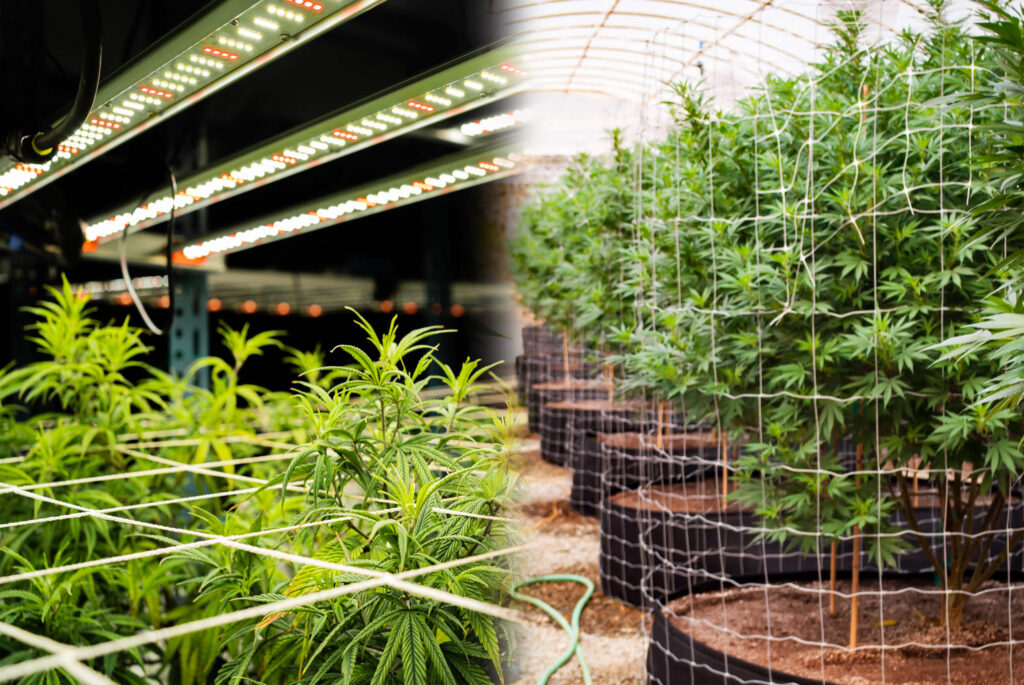
Vertical cannabis trellises, on the other hand, are more similar to the regular trellises you’d see in a vegetable garden. They can be made of many different materials, though trellis nets are particularly popular (especially indoors). They run perpendicular to a plant’s main stem and don’t do much to alter its upward growth. However, vertical trellises are very effective at supporting branches during flowering, and gently opening up bushy plants.
While it’s not very common in cannabis cultivation, trellises can also be set up along a wall. Growers can then use a combination of pruning and training techniques to teach their cannabis plants to grow along the trellis, creating a large vertical canopy.
Again, it’s not a very common technique, but it’s technically a creative and effective use of space (such as large vertical patio walls that get a lot of sunlight). Another perk of growing next to a wall is ‘thermal mass’; walls absorb heat during the day and radiate it back at night. Additionally, walls provide a windbreak that protects plants from damaging gusts. Especially helpful for those growing in colder climates!
What’s the difference between cannabis trellising and ScrOG?
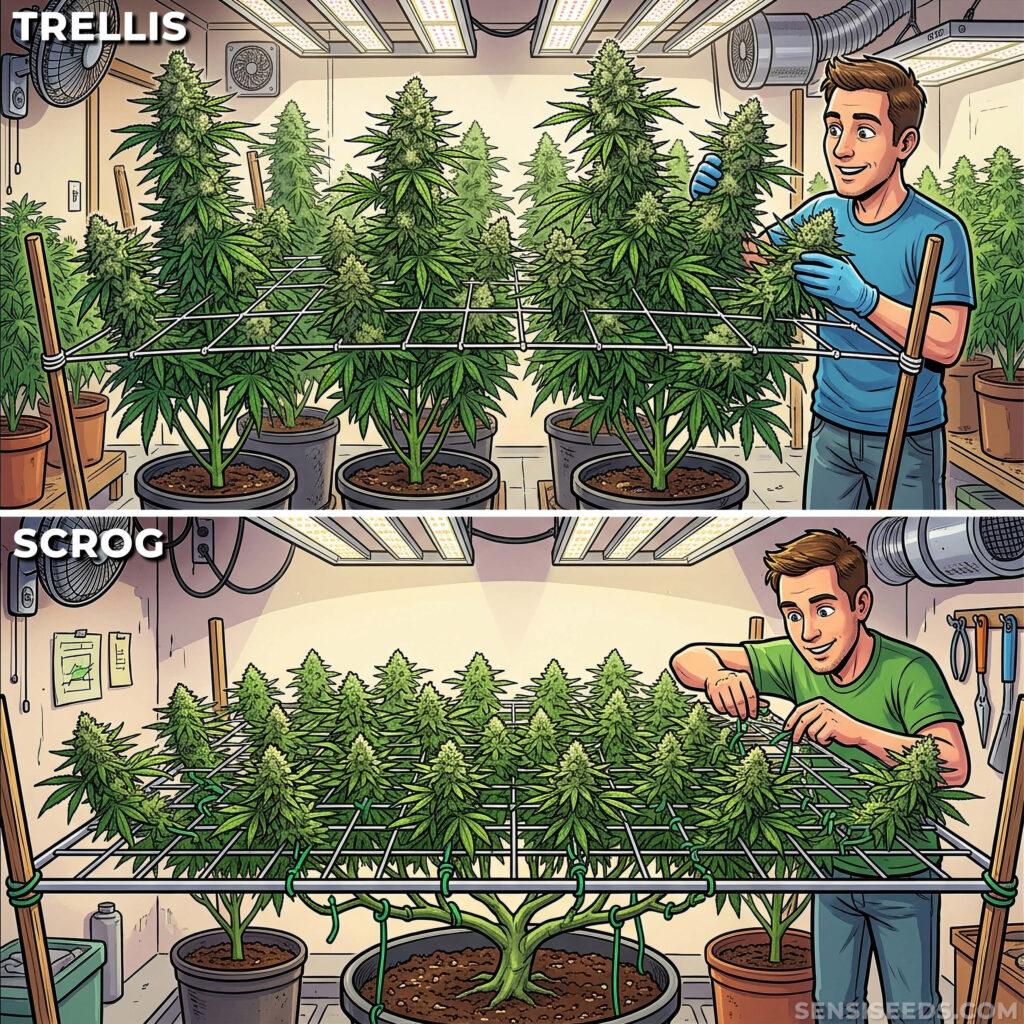
At first, cannabis trellising and ScrOG might seem very similar (if not identical). However, there are some differences that separate the two:
- Trellising is, broadly speaking, more focused on providing plant support. While it also involves guiding plant growth, it’s less hands-on than the ScrOG method, and less of a training technique. Instead, trellising focuses on gently opening up a plant’s canopy and, above all, providing structural support, especially during bloom.
- ScrOG, though it uses a horizontal trellis screen or cannabis net, also relies heavily on low-stress training (LST) and topping. Usually, ScrOG growers repeatedly top or FIM their plants, encouraging the growth of multiple colas. Simultaneously, they use LST to bend their plants´ branches and stems, encouraging them to grow along a horizontal screen (or trellis). The goal here is to create a completely even canopy that occupies most of the available space and makes the most of every ray of light.
The benefits of trellising: Why trellis cannabis plants?
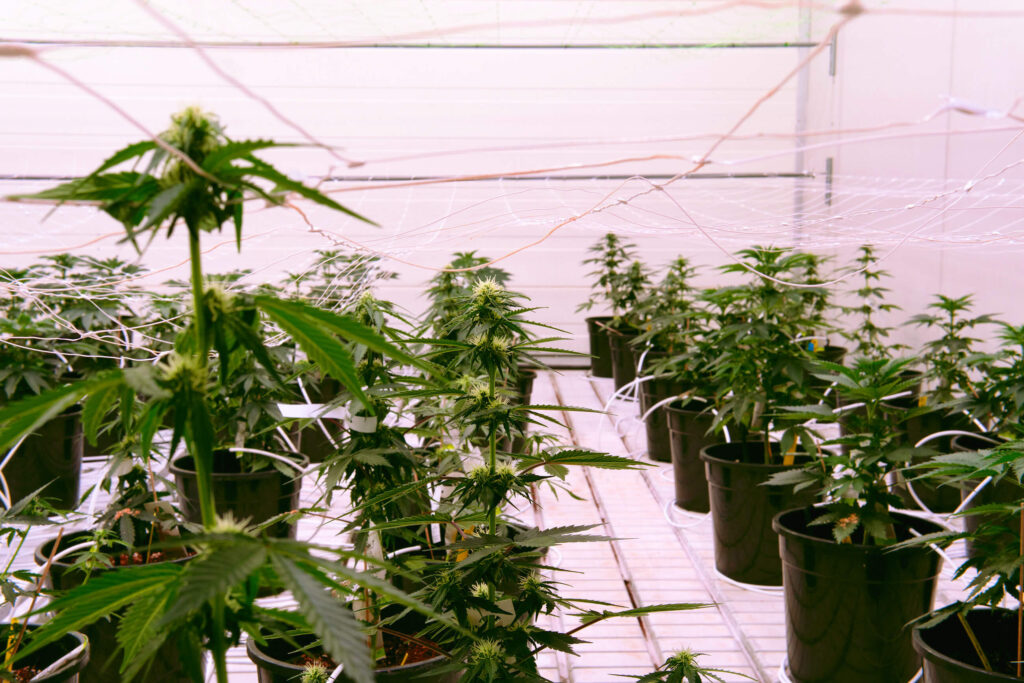
The benefits of trellising cannabis are similar to those of trellising any other plant. These include:
1. Enhanced light distribution
By opening up the canopy, trellising allows light to more effectively penetrate the plant, reaching more bud sites and encouraging the growth of bigger buds.
2. Improved airflow
Ventilation is essential when growing cannabis, as it helps maintain steady temperatures and humidity levels. Improper airflow, on the other hand, can promote pests and pathogens.
3. Easier handling
By opening up a plant’s structure and providing support, trellises facilitate access throughout the canopy, making pruning, defoliation, and regular inspection a breeze.
4. Structural plant support
Plants spend a considerable amount of their energy on simply staying upright, especially in windy conditions. By sustaining their branches and stems, therefore, trellises help them save energy which, in turn, they can use to fuel more vegetative growth or develop bigger buds, with more resin. As your plants mature and bloom, this structural support becomes ever more important.
Related post
Cannabis trellis methods: How to use trellising when growing weed
Excited to take advantage of this age-old gardening technique? Below, we’ll walk you through how to use vertical and horizontal supports, ScrOG, and cannabis trellis netting to maximise the growth of your plants:
How to use vertical staking and plant support for cannabis
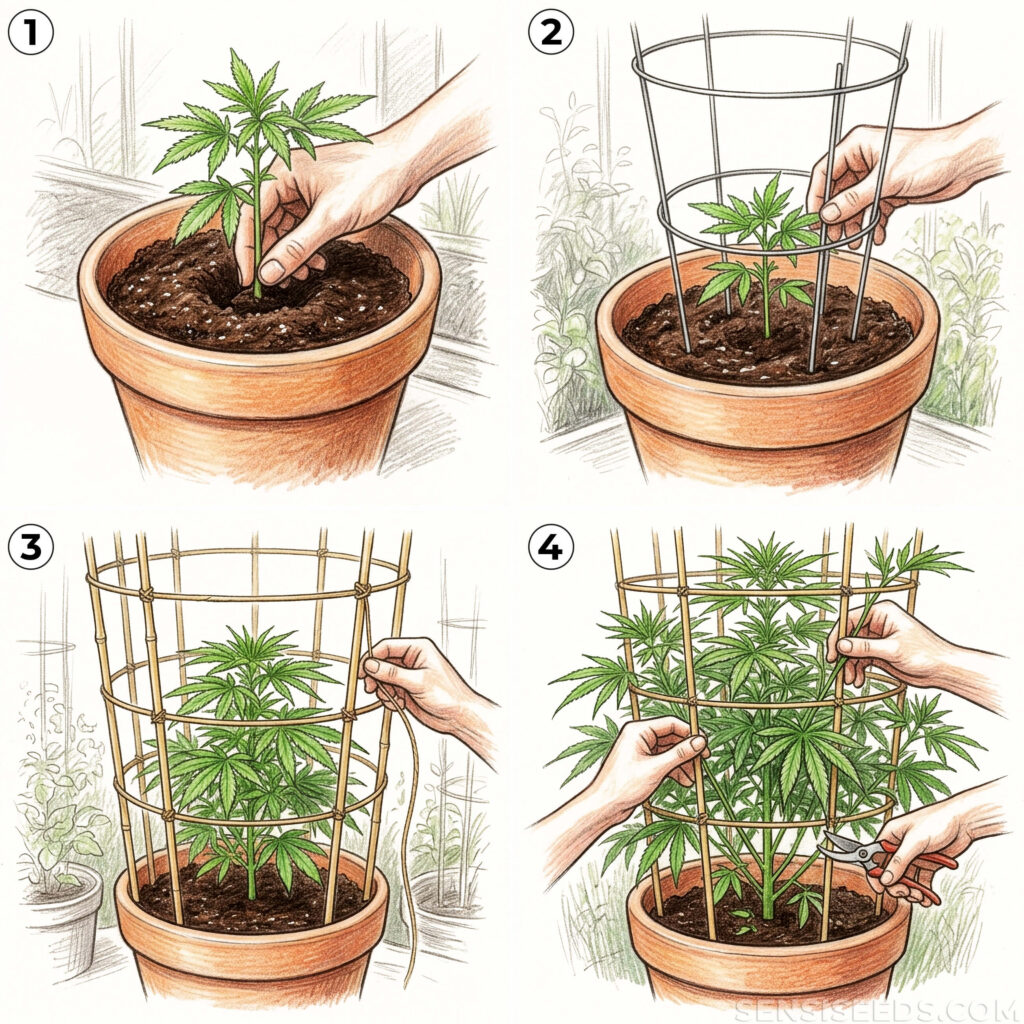
Vertical cannabis trellises and staking are usually used outdoors, though they can also be used in tents or rooms. Here’s a basic step-by-step guide to vertical cannabis trellising:
- Germinate your seeds and guide them through the seedling stage as you normally would. Once they’re ready to be transplanted, plant your seeds in their final containers (you won’t be able to transplant them later without disassembling your entire trellis).
- After transplanting your seedlings, install a tomato cage around them in the centre of their pots. This will serve as an internal plant support system and help you guide and support your plants’ growth during the early stages of vegetation.
- Build a trellis or staking around your pots during the late vegetative stage or early flowering:
- Choose durable, weather-resistant materials both for the vertical staking and cross beams (wood, metal, and PVC are all common choices).
- Place four sturdy vertical stakes around your pots in a square formation. Each post should be around 30 cm from the centre of the pot.
- Use metal caging to create two horizontal trellises: one just above the top of the tomato cage, and another one roughly 45 cm further up.
- Finish the structure by using metal caging or plastic/rope netting to cover the four open sides around your plants, creating a cage-like structure.
- Remember that your trellis should be taller than the plants you plan to grow. Be sure to consult the size of your strain with your seedbank, and consider using some early topping/FIMming to promote more compact growth.
- As your plants grow, feed their shoots through the horizontal and vertical rungs of your cannabis trellis. You can utilise gardening tape, string, or zip ties to gently hold your plants in place. Use LST, topping, or FIMming as you see fit to promote healthy new growth and direct it properly. Use pruning or defoliation to further open up the structure of your plants as they grow, promoting good light penetration, airflow, and plant support.
How to use horizontal trellising for cannabis
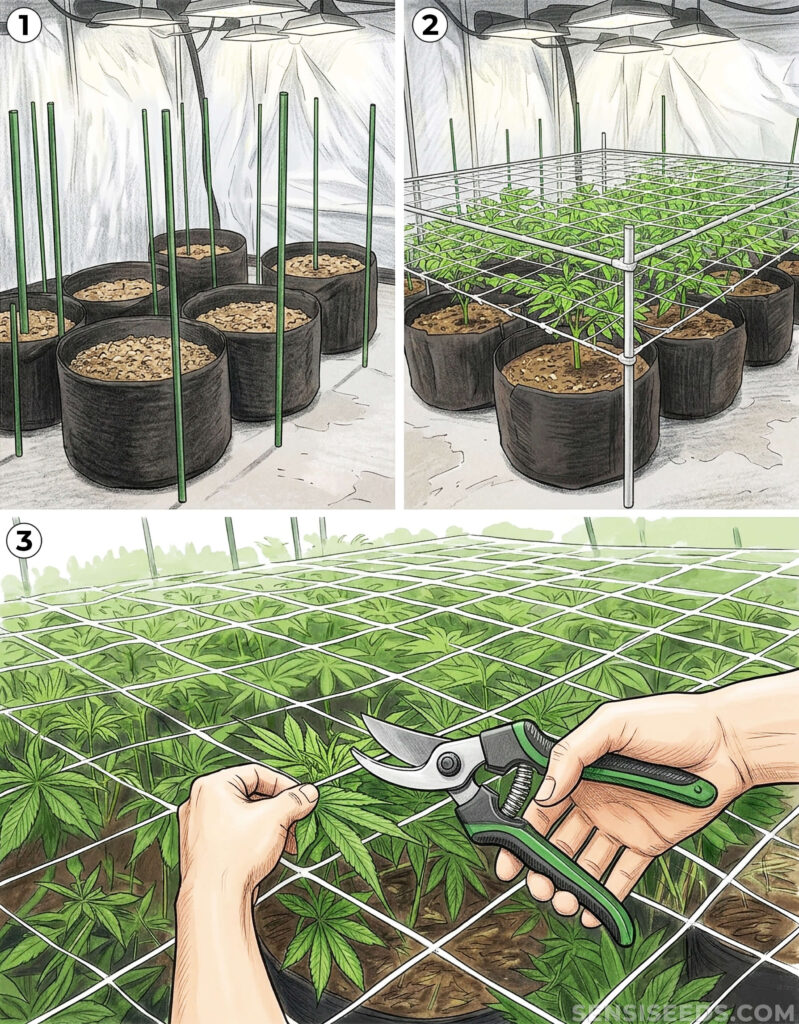
Horizontal trellises are the norm in the world of cannabis. They usually use multiple layers to provide support to plants at all stages of their growth cycle. Here’s a step-by-step guide to installing horizontal cannabis trellises and using trellis netting for cannabis (applicable both indoors and outside):
- Install vertical support beams outside your pots at a greater distance than when making a vertical trellis (roughly 50-60 cm from the centre of your pots). Consider using six vertical supports rather than four for greater stability.
- Attach metal caging or rope/plastic cannabis netting to the supports. The caging/net should be parallel to the ground. Place the first layer roughly 40 cm above the top of the pot, and the subsequent layers roughly 40 cm apart.
- Feed the shoots of your plants through the trellis as they grow. Use topping and FIMming early on to promote the growth of multiple colas, as well as defoliation and pruning to promote light penetration and airflow. Use string, rope, or gardening tape to secure the stems and branches of your plants to the trellis.
How to use ScrOG
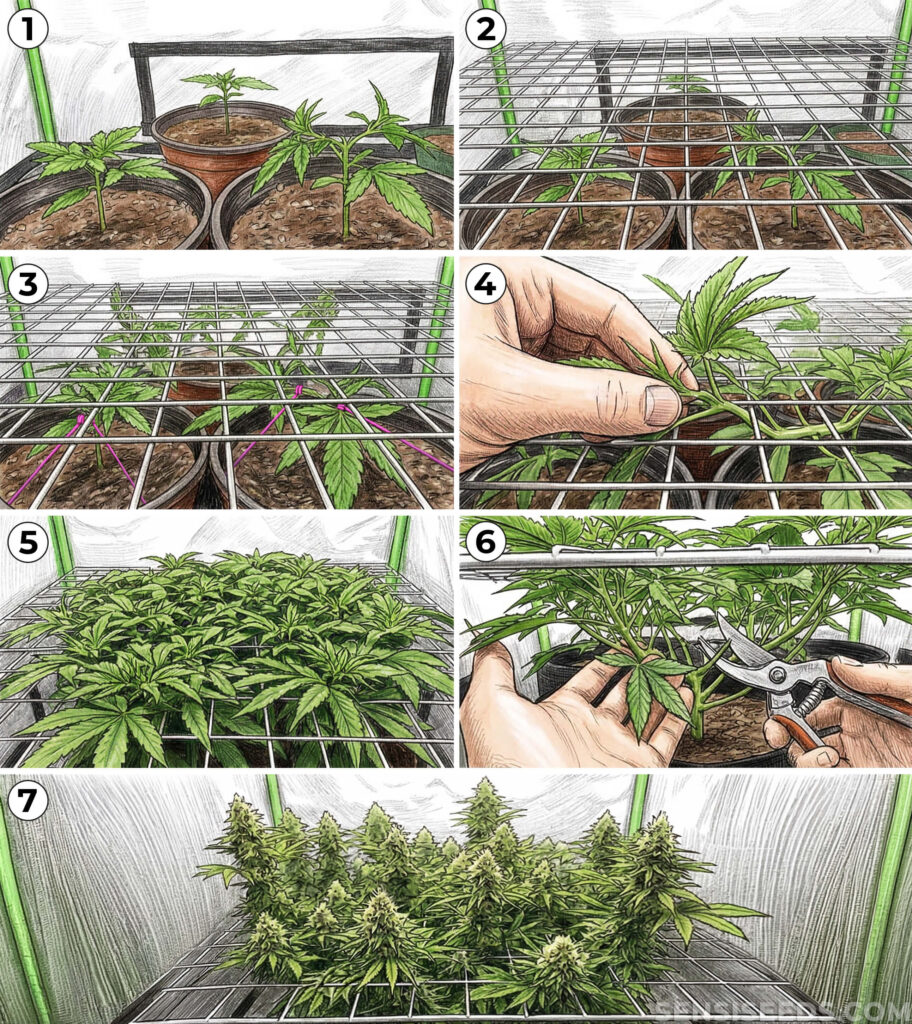
Looking for an even heavier harvest? ScrOG uses horizontal trellising and intense training to create a flat canopy that, in bloom, fills with nothing but big colas. Here’s how to use it to take your next grow to new heights:
- Germinate your seeds. Once your plants are in their final containers and well into the vegetative phase, use Topping and FIM to promote the growth of multiple colas. Also, use LST to bring down the new shoots and begin coaxing your plants into a horizontal growth pattern.
- Install a screen above your plants (between 20-60 cm above the top of their pots, depending on the strain). Keep your plants well-spaced (at least 30 cm apart).
- As your plants begin to grow closer to the cannabis net, continue to use topping/FIMming and LST to promote bushy, compact growth.
- As different parts of your plants grow above the screen, tuck them back under it. You can use tape or string to hold shoots in place, though this usually isn’t necessary.
- The idea of ScrOG is to create a completely flat canopy. To do this, you need to keep all new growth growing across the screen, not over it.
- As your canopy fills out the screen, use defoliation and pruning to remove any foliage below it.
- Trigger flowering. Once you do, your plants will stretch, and you’ll need to keep feeding their foliage through the screen. The only parts of the plant allowed to grow through the screen should be the flowers. Regular pruning during the veg phase and very early bloom can help control the growth of leaves and maximise the amount of light hitting your plants’ bud sites.
Check out our dedicated article on ScrOG to master this highly effective training technique!
Related post

Cannabis trellising best practices (and common mistakes to avoid)
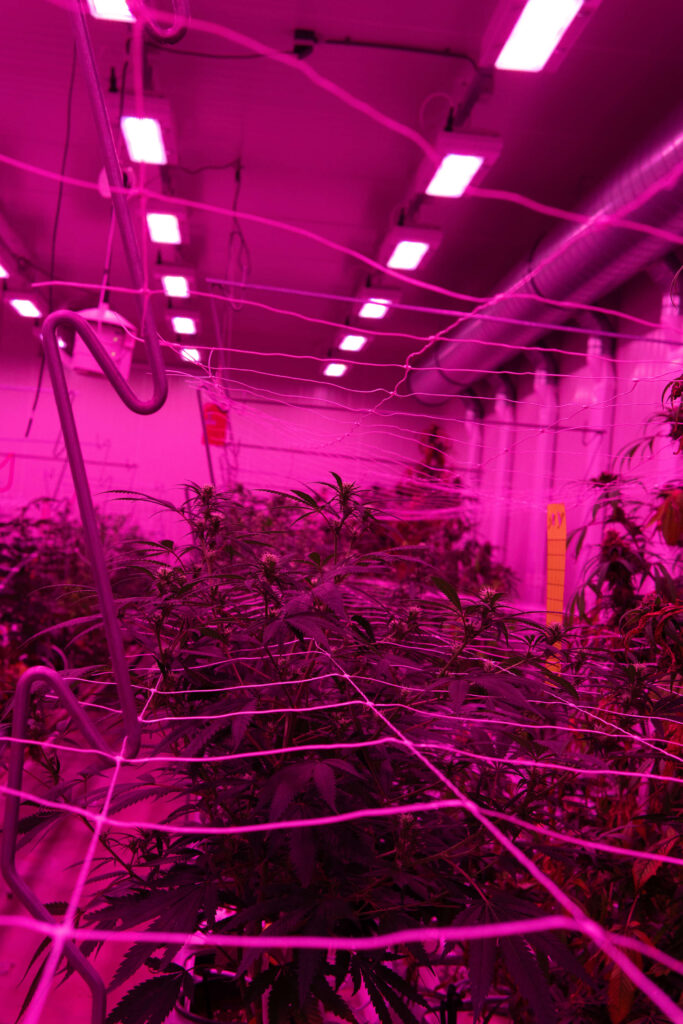
- Install your trellis at the right time. Vertical trellises can be installed during the late vegetative or early bloom phase. Horizontal trellises and ScrOG screens, on the other hand, should be installed during early vegetation.
- Use sturdy materials for the trellis support, and tight netting/cages. Slack nets or ropes won’t properly support your branches. Tension is required to keep your plants’ branches/stems upright.
- Choose the right mesh size. This will really depend on your grow space, as well as the strain you’re growing and the size of your plants. However, 8-15 cm grids generally work well.
- Be gentle. Learn to tuck and weave your plants gently, and use only safe materials (string, gardening tape, or plant ties) to hold your plants in place.
- Plan for plant access early. Make sure your trellis doesn’t impede your ability to water, feed, or otherwise tend to your plants.
- Use other techniques to further improve plant growth. Topping, LST, lollipopping, and defoliation can compound the benefits of cannabis trellising.
- Maintain good airflow and the right conditions. Trellising promotes the growth of denser canopies that can trap moisture and heat. Compensate with good, steady ventilation.
- Cut your cannabis trellis net or plants at harvest. Don’t try to feed mature branches through your screen or net; you’ll only risk damaging your buds.
Cannabis trellising FAQs
A: Vertical trellises can be installed during late veg/early bloom. Horizontal trellises and ScrOG screens, however, should be installed during the early veg phase.
A: Yes! Just be extra gentle. Since autoflowers have a set vegetative cycle, it’s best to trellis them lightly and avoid more intense training methods like topping or LST (which auto plants struggle to recover from).
A: No, cannabis trellises aren’t necessary to grow cannabis indoors. However, horizontal trellises or ScrOG can really improve the yields of indoor cannabis plants.
A: If you’re using trellises made out of wood, PVC, or metal, you’ll need to cut down your plants to be able to get them out. In this case, you can reuse your trellis. If you’re using a trellis made out of plastic or rope netting, however, it’s easier to just cut the trellis in order to remove it come harvest time.
Do you use a cannabis trellis outdoors or in a grow tent? Share your experience with us and our readers in the comments below!
- Disclaimer:Laws and regulations regarding cannabis cultivation differ from country to country. Sensi Seeds therefore strongly advises you to check your local laws and regulations. Do not act in conflict with the law.