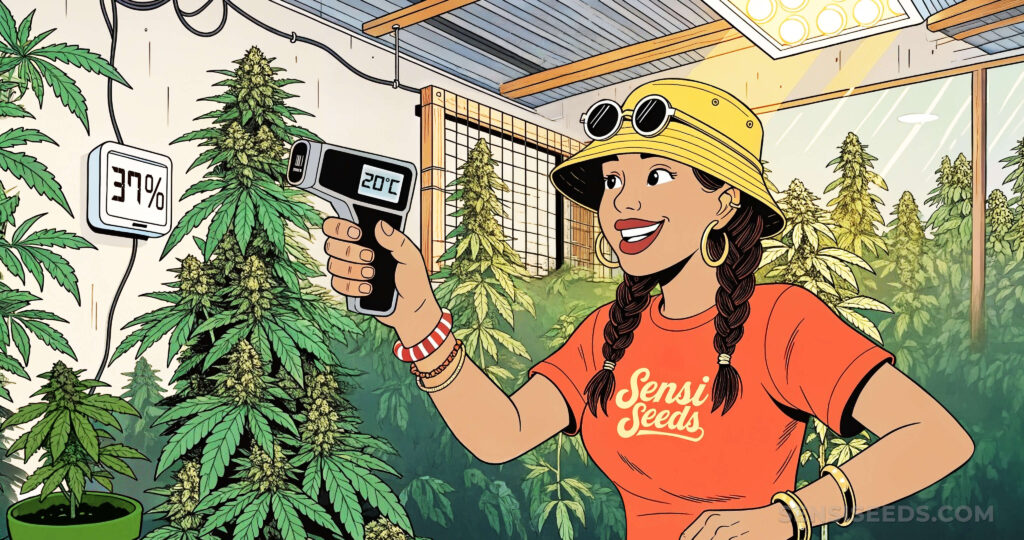
Ready to push your genetics to their limit? Master transpiration with this expert cannabis VPD chart, the key to maximising nutrient uptake, vegetative growth, and resinous flower production! Learn how to calculate and control VPD in your room and tent, and optimise your environment for the seedling, veg, and bloom phase. Top-shelf harvests await!
- What is cannabis VPD (Vapour Pressure Deficit)?
- Leaf Surface Temperature (LST): The key to mastering VPD (and the downfall of most cannabis VPD charts)
- How to measure and calculate VPD at home (step-by-step)
- Cannabis VPD chart: The optimal ranges
- A note on night cycles and CO2
- Practical crop steering: How to adjust VPD in your grow room (step-by-step)
- Cannabis VPD troubleshooting: Reading the signs of high vs. low VPD
- Cannabis VPD FAQs
For beginner and intermediate growers, managing basic environmental variables like lighting, ventilation, temperature, and humidity is usually enough to grow healthy cannabis plants and harvest great flower. Cannabis VPD charts, however, are what expert cultivators use to maximise the genetic potential of their plants.
Cannabis VPD (Vapour Pressure Deficit) goes beyond simple environmental metrics like temperature and relative humidity (RH). Instead, it lets growers master transpiration (the driver of nutrient uptake) and steer their crops towards vegetative or generative growth for a top-shelf harvest.
Below, we break down cannabis VPD charts and teach you:
- How VPD affects transpiration and the rate at which your plants absorb nutrients/water from their soil.
- How to use VPD to crop steer your plants towards vegetative or generative growth.
- The ideal VPD ranges for:
- Seedlings/clones: 0.4-0.8 kPa
- Vegetative growth: 0.8-1.0 kPa
- Generative growth (bloom): 1.2-1.5 kPa
- How to calculate VPD accurately using the golden metric of Leaf Surface Temperature.
- How to optimise VPD during “lights off” by increasing humidity and stave off the “dew point.”
- How to increase VPD in CO2 supplemented gardens, where plants transpire less and can handle more heat.
What is cannabis VPD (Vapour Pressure Deficit)?
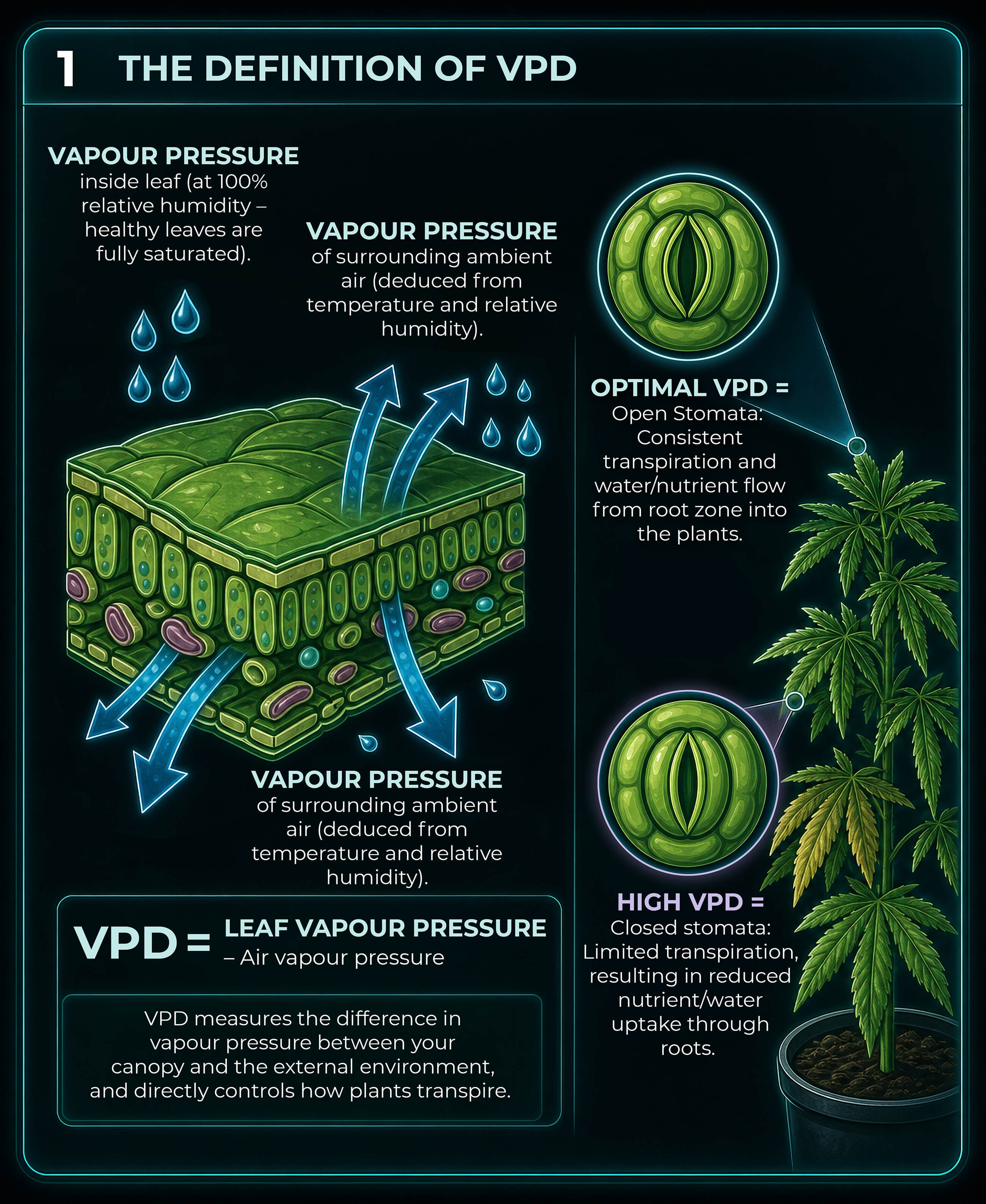
Cannabis VPD is a measure of the difference in water levels inside your plants’ leaves and their environment. It is typically measured in kilopascals (kPa) and, when tracked precisely, allows you to maximise transpiration rates to steer your plants towards vegetation or flower growth.
The classic VPD definition
Google VPD, and you’ll find this textbook definition almost everywhere:
“Vapour Pressure Deficit is the difference between the current levels of moisture in the air and the maximum amount of moisture the air could hold before reaching saturation (i.e. the dew point).”
To realise the true potential of VPD and its effect on plants, however, we like to go beyond the textbook and think of it as the driving force of plant transpiration. By comparing the water levels between your canopy and growing environment, VPD tells you how much water (and, by extension, how much fertiliser) your plants are able to pull out of their medium.
Maximum transpiration: What happens when cannabis VPD is optimal?
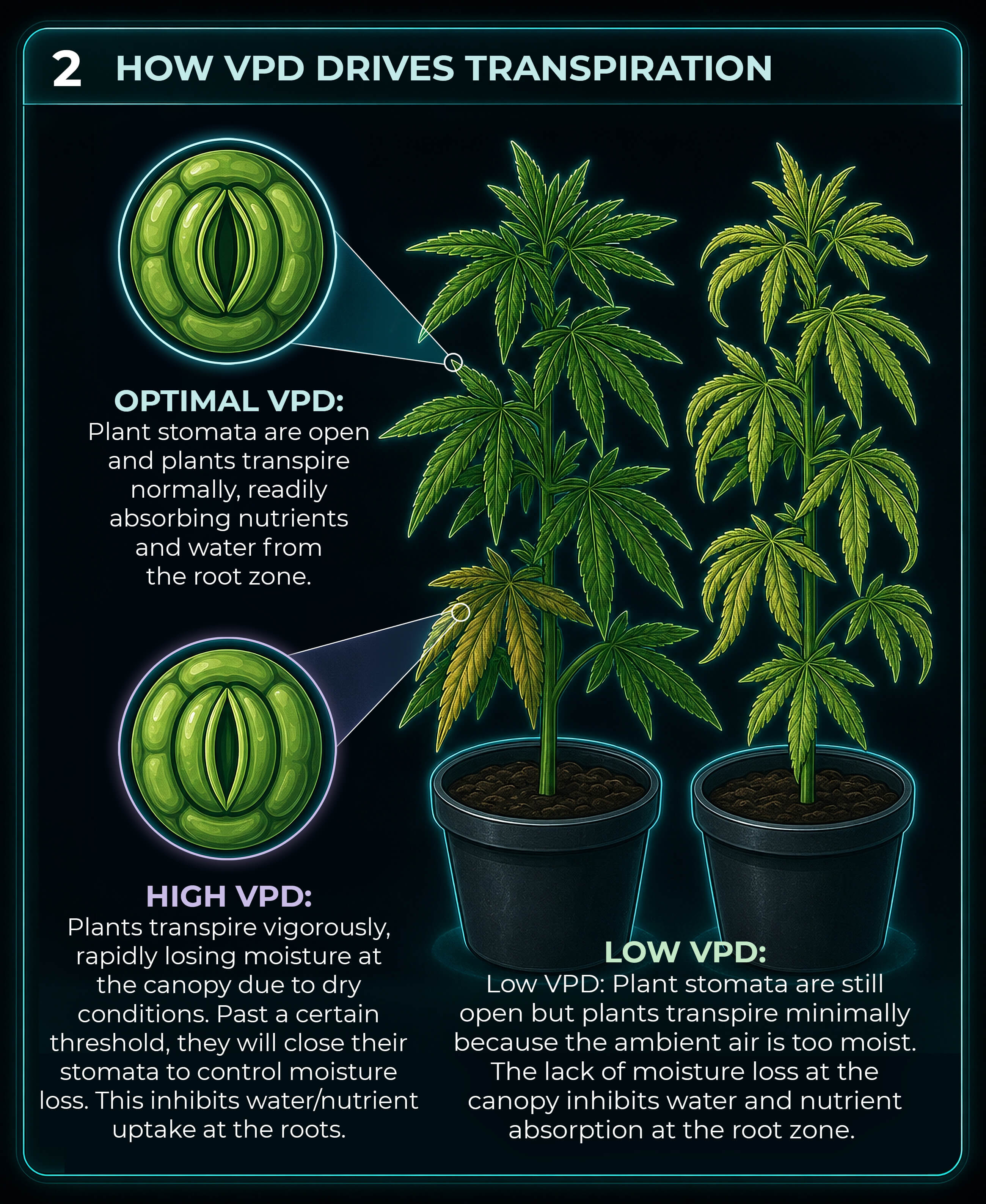
The best VPD for cannabis is between 0.8-1.5 kPa for mature plants. At these rates, the air in your grow room is dry and warm while your plants are well hydrated.
This deficit creates a natural pull that draws moisture in from the roots of your plants, up through their xylem and, eventually, out through their porous stomata. All plants rely on this process (known as transpiration) to be able to take up water and nutrients from the ground.
When you optimise cannabis VPD in your grow room, your plants transpire at high rates, fuelling the growth of lush foliage during veg and dense, resinous buds during bloom (as you’ll see below, higher VPD is key for generative crop steering).
Drive VPD too high, however, and your plants will transpire too much and be at risk of dehydrating. In turn, they’ll close their stomata entirely and stop photosynthesising. Finally, when VPD is too low, your plant’s stomata remain wide open, but the lack of a sufficient deficit in water pressure means they’ll transpire slowly and pull less water/nutrients from their medium.
How is cannabis VPD calculated?
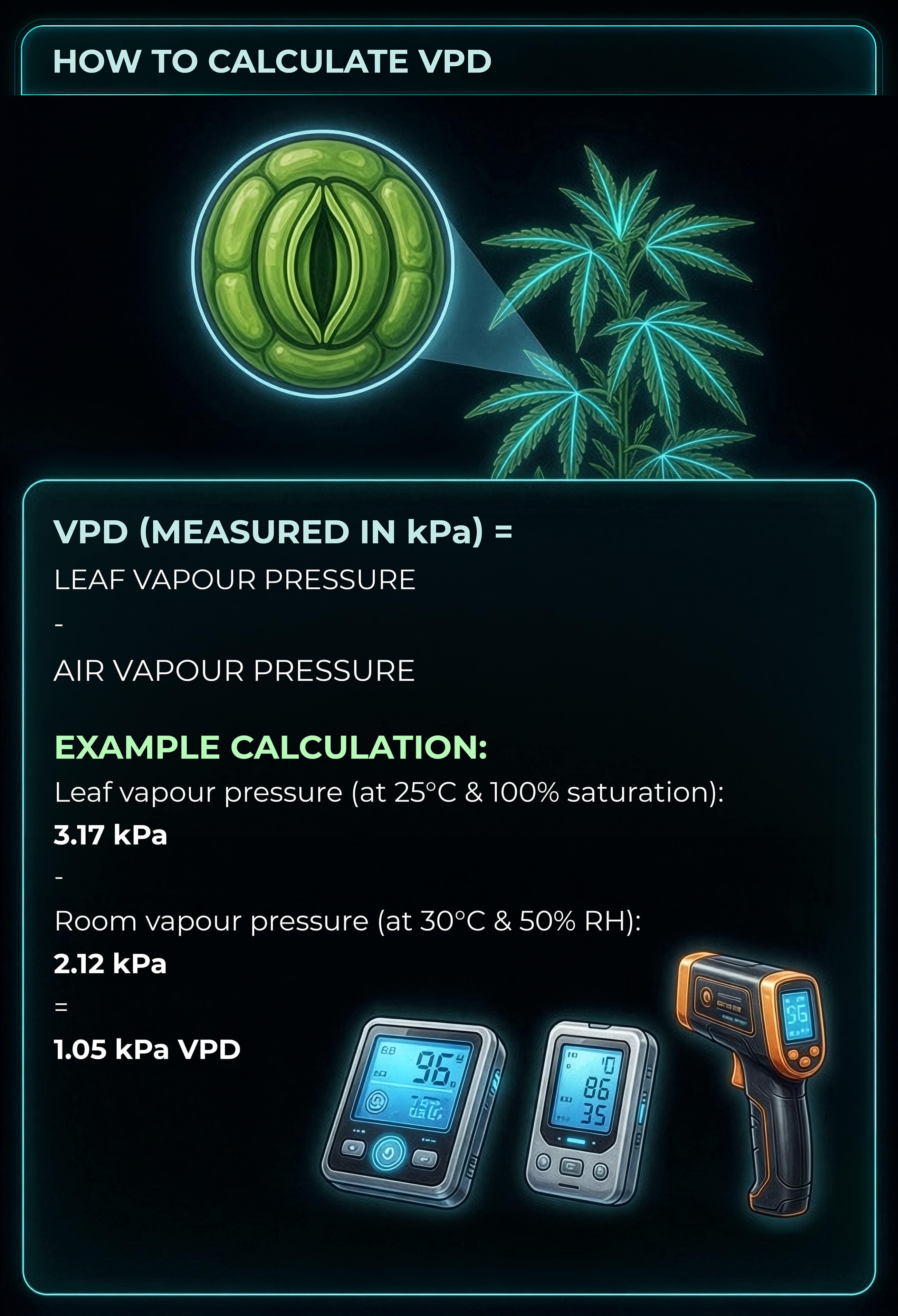
Getting an accurate reading of cannabis VPD relies on three key variables:
- The ambient temperature. This tells you how much moisture the air in your room/tent could hold before reaching saturation.
- Relative humidity (RH). This tells you how much moisture the air is currently holding.
- Leaf surface temperature (LST). This determines the vapour pressure (VP) inside the leaf (healthy cannabis leaves are nearly 100% saturated).
Using these metrics, you can calculate the VP of your environment and subtract it from the VP of your leaves to identify the deficit.

Leaf Surface Temperature (LST): The key to mastering VPD (and the downfall of most cannabis VPD charts)
Lots of growers make the mistake of measuring the conditions of their room using thermohygrometers, then simply guessing the temperature of their leaves. And we don’t blame them; many legacy cannabis VPD charts encourage this guesswork by suggesting that LST is usually just 1-3°C (3-5°F) cooler than the ambient temperature.
The reality, however, is that the temperature of your leaves can vary greatly based on:
- The type of grow lights you’re using. High-Pressure Sodium (HPS) and Metal Halide (MH) lamps produce much more residual heat than LEDs, meaning they have a greater effect on the ambient temperature in your room/tent.
- The distance between your lights and the canopy. The closer your lights are to your plants’ leaves, the higher your LST.
- The amount of ventilation in your space. Fans and exhausts help reduce both temperature and humidity.
- Your local climate (which impacts the conditions inside your room/tent).
The IR thermometer: An essential tool for measuring cannabis VPD
Remember: VPD is ultimately about the water pressure difference between the saturated interior of a plant’s leaves and the air outside it. Because temperature dictates how much moisture air can hold, it’s impossible to get an accurate VPD calculation if you don’t know exactly how warm your canopy is.
Don’t fall into the trap of blindly following basic cannabis VPD charts. Invest in an infrared (IR) thermometer and regularly take accurate readings of the temperature of your leaves across different areas of the canopy to find your true average LST. You’ll be surprised just how much it can vary!
A note on the LED revolution
The move to LED grow lights has a huge impact on how growers manage VPD. The HPS and MH grow lamps that dominated indoor grow rooms only 20 years ago emitted significant infrared heat that directly warmed leaf tissue and the air around plants.
Today, most growers use LED grow lights that are much more efficient and subsequently run much cooler. To compensate for lower leaf surface and grow room temperatures, LED growers typically have to use auxiliary heating and humidifiers to up their plants’ metabolism and ambient temperatures in order to hit the VPD sweet spot.
How to measure and calculate VPD at home (step-by-step)
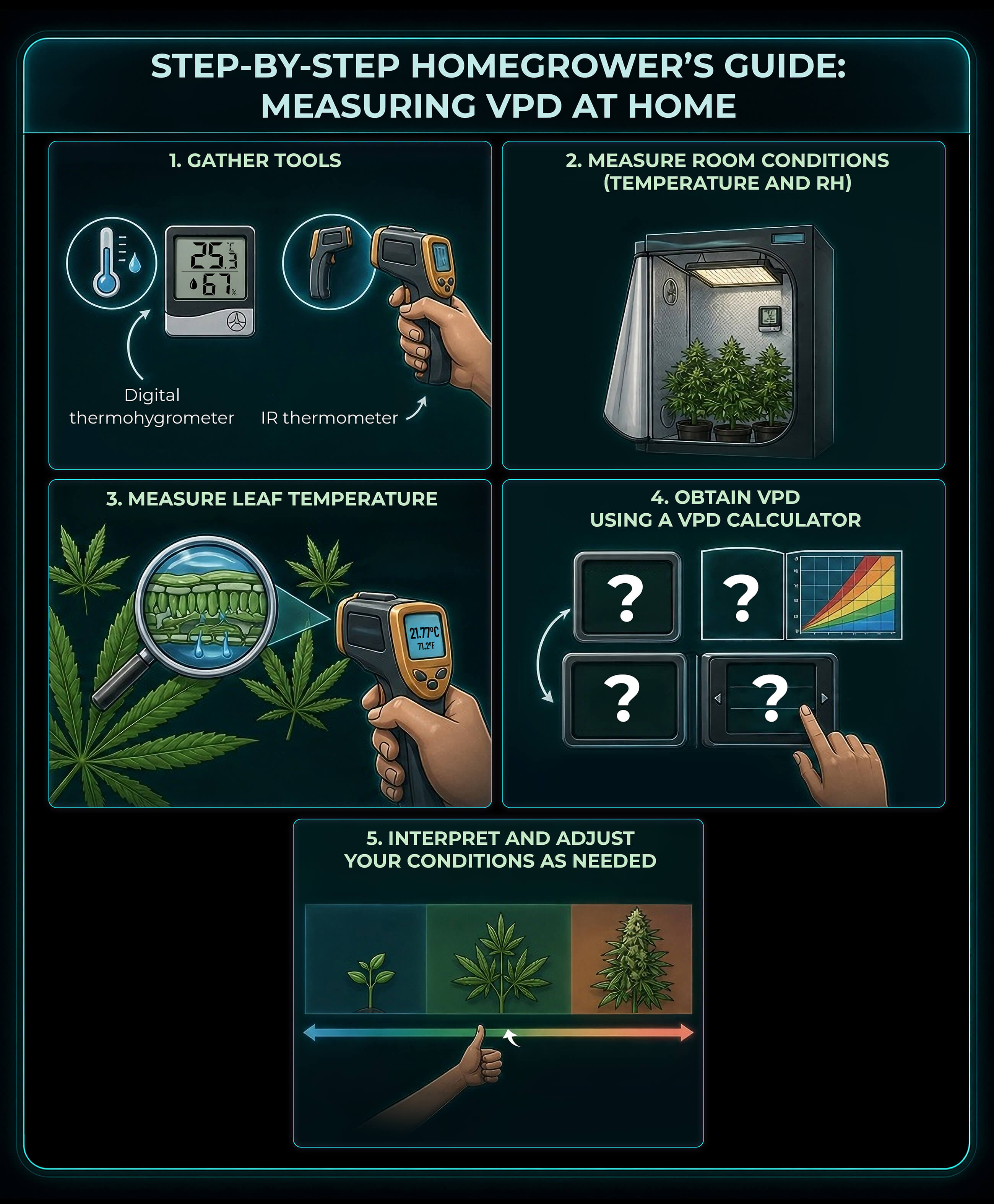
Ready to move beyond guesswork and take control of your crops? Here’s how to calculate VPD when growing cannabis:
- Use a thermohygrometer to measure the ambient temperature and relative humidity (RH) inside your room/tent.
- Use an infrared (IR) thermometer to measure leaf surface temperature (LST).
a. Don’t just take one reading. Measure the LST of leaves directly under your grow lights, as well as those sitting slightly lower or in the shade.
b. Add together these numbers and divide them by the total number of samples you took to find your average LST. - Take your air temp, RH, and average LST and plug them into a cannabis VPD chart or calculator. The VPD is the difference between the leaf vapour pressure (VP) and air VP.
Pro tip: Smart sensors can automatically calculate VPD. Even when using these sensors, however, doing a manual calculation once a week can help you catch any subtle errors early and tweak your conditions accordingly.
Cannabis VPD chart: The optimal ranges
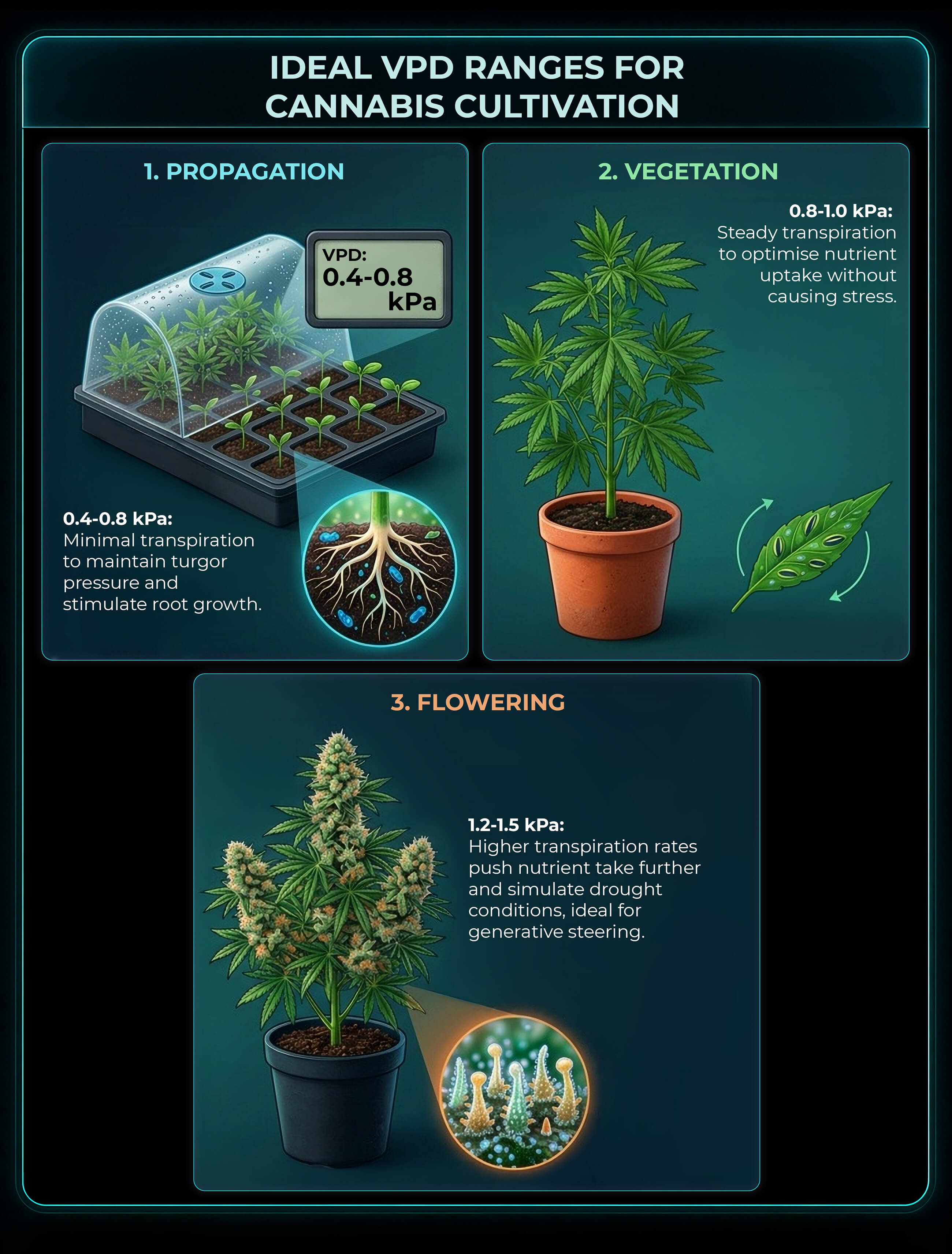
Below, we’ll walk you through the ideal VPD ranges for propagation, veg, and bloom.
Propagation: VPD for clones and seedlings
Ideal VPD: 0.4-0.8 kPa
Clones and seedlings have little or no root systems. High VPD pulls too much moisture from them, causing stunted growth or damping off. Maintaining low VPD during the propagation/seedling phase, on the other hand, minimises moisture loss and promotes root growth.
Foliar growth: VPD range for veg
Ideal VPD: 0.8 (early veg/late propagation) – 1.0 kPa
During veg, your main goal is promoting the rapid production of biomass to end up with well-structured plants capable of yielding large amounts of flowers. To do this, bring VPD to 0.8 kPa during the end of the seedling phase and up to 1.0 kPa during the middle of veg. At these rates, your plants will transpire optimally, taking up the nutrients and water they need to fuel foliar growth as well as the CO2 they need for photosynthesis.
Bloom: Ideal VPD for flowering
Ideal VPD: 1.2-1.5 kPa
During bloom, expert growers use drought stress as a form of controlled generative steering. By driving up VPD and increasing the drying power of the atmosphere, you force your plants to produce more abscisic acid – a hormone that signals the production of reproductive flowers.
Higher VPD also equals drier air, which is your best defence against Bud Rot (Botrytis) and Powdery Mildew during late flowering.
Related post

A note on night cycles and CO2
Managing VPD during the day is only half the battle. Unfortunately, many growers make the mistake of completely ignoring the VPD in their rooms during the dark cycle.
Grow lights (even LEDs) are usually the #1 source of heat in small tents and rooms. When they switch off, temperatures often plummet, driving down VPD and creating dew.
The “Dew Point” (DP) danger: How to manage humidity spikes and “night sweats”
If nighttime temperatures in your room/tent drop too far, you’ll hit the Dew Point (DP) – the moment that moisture in the air condenses on your plants’ leaves and flowers. Known as the “night sweats,” this is one of the leading causes of Bud Rot and Powdery Mildew during bloom.
The best way to prevent cannabis night sweats is to run a dehumidifier during the evening to keep VPD from crashing.
The carbon variable: Ideal VPD rates when supplementing with CO2
When supplementing with CO2, keep your VPD at 1.1-1.2 kPa during veg, and 1.5+ kPa during bloom. Note that the simplest way to do this is by increasing the ambient temperature in your space.
Plants in CO2-supplemented gardens have a higher temperature tolerance, and hot air increases the pull of transpiration by absorbing more moisture from the surface of your plants leaves. If you don’t adjust your VPD accordingly, you may see signs of stunted growth as your plants struggle to take up water and nutrients (particularly immobile ones like calcium and magnesium).
Related post
Practical crop steering: How to adjust VPD in your grow room (step-by-step)
Elite cannabis cultivation isn’t about reacting to environmental changes. It’s about controlling the environment to steer your crops towards the right kind of growth (vegetative or generative). And VPD is at the heart of that. Here’s how to bring VPD up or down and boost your yields:
How to reduce VPD
- Use a humidifier to up the RH in your space. This is the fastest way to close the deficit and halt excessive transpiration.
- If you don’t have a humidifier, increase RH by:
a. Placing trays of water in your grow space to drive up humidity via evaporation
b. Mist your plants (veg only). This physically adds more moisture into the air.
c. Reduce your exhaust and/or oscillating fans. This allows more moisture to build up inside the tent as your plants transpire. - If needed, reduce your ambient temperature by:
a. Dimming your lights or moving them further away from your canopy.
b. Using air conditioning.
How to increase VPD
- Use a dehumidifier to lower RH.
- If you don’t have a dehumidifier, reduce the RH in your grow room/tent by:
a. Increasing ventilation.
b. Watering your plants less frequently (if possible).
c. Defoliating your plants regularly (during veg). - Increase your ambient temperature if necessary by:
a. Increasing the intensity of your lights.
b. Reducing your oscillating and exhaust fans.
Related post

Cannabis VPD troubleshooting: Reading the signs of high vs. low VPD
High VPD symptoms:
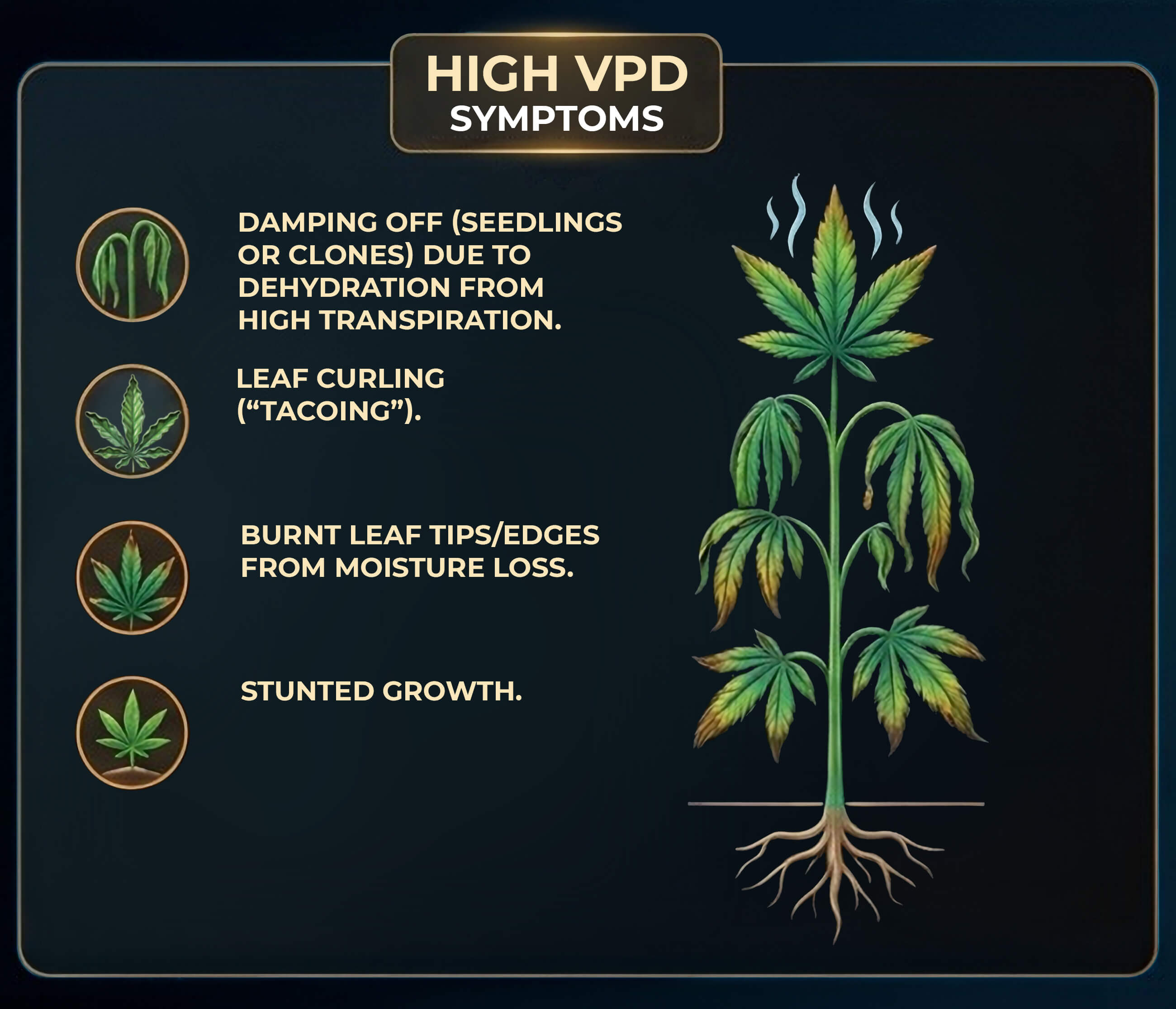
Common signs and symptoms of high cannabis VPD are:
- “Damping off” (in seedlings or clones). VPD drives transpiration, which can dehydrate seedlings/clones with underdeveloped root systems.
- Leaf curling (“tacoing”). In an effort to conserve moisture, cannabis plants may curl their leaves to reduce the surface area exposed to dry air.
- Burnt leaf tips/edges. High VPD draws too much moisture from your plants, burning and crisping their foliage.
- Stunted growth. To prevent dehydration, your plants will close their stomata, halting CO2 uptake and photosynthesis.
Low VPD symptoms:
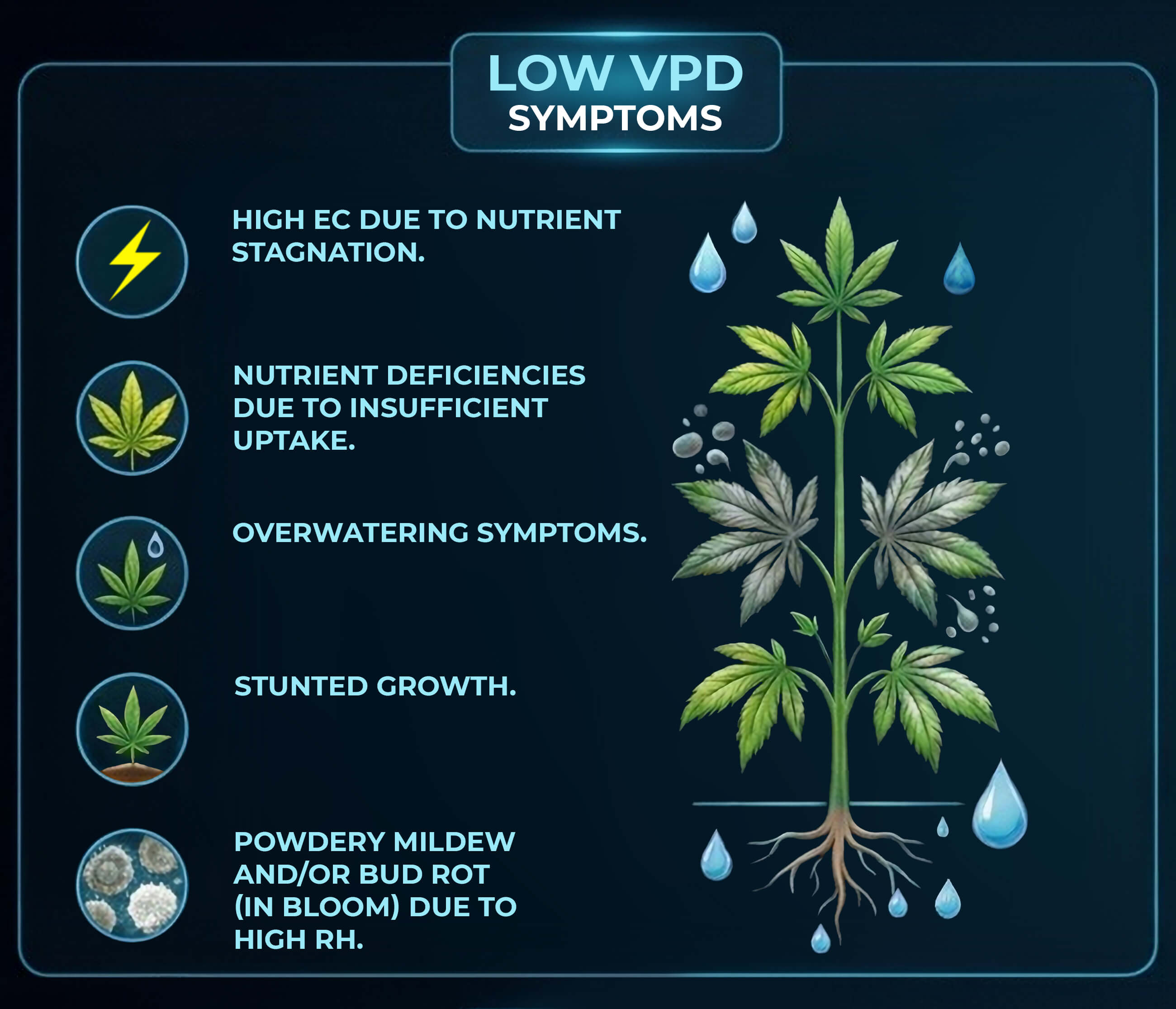
Common signs and symptoms of low cannabis VPD are:
- Nutrient stagnation. The EC or PPM in your medium may be too high, due to fertiliser buildup. Even though you’re feeding your plants the necessary nutrients, they can’t absorb them when VPD is too low for adequate transpiration.
- Nutrient deficiencies. Low VPD affects your plants’ ability to take up immobile nutrients like calcium, sulphur, iron, boron, and copper, leading to deficiency symptoms. Learn to identify common cannabis deficiencies here.
- Overwatering. As your plants struggle to take up water from their soil, it may stay damp for prolonged periods of time, suffocating the roots and causing signs of overwatering. Learn to diagnose, fix, and prevent overwatering here.
- Bud Rot (Botrytis). Stagnant, high-humidity environments create a breeding ground for pathogens. Moisture trapped in thick flowers attracts Botrytis, which can cause entire colas to rot.
- Powdery Mildew. Like Botrytis, Powdery Mildew thrives in humid environments choked by low VPD. Learn how to identify and prevent Powdery Mildew and Bud Rot here.
Related post
Cannabis VPD FAQs
A: Legacy VPD charts highlight the ideal VPD ranges for cannabis throughout veg and bloom. Take accurate measurements of the air temperature and RH in your room, as well as the average LST across your canopy, then use a VPD calculator to calculate the deficit in vapour pressure (VP) between the air and your plants’ leaves. Aim for the VPD rates outlined in the charts (they are usually colour-coded green) and avoid estimating your LST as this leads to inaccurate readings.
A: VPD dictates how efficiently water travels from your medium up through your plants and back into the atmosphere via transpiration. The larger the deficit in VP in your grow room, the more water evaporates from your plants’ leaves back into the atmosphere and the more water/nutrients your plants absorb from their medium.
A: Measuring leaf VP is essential to getting an accurate VPD reading. Relying solely on room VP and an estimate of your leaf surface temperature (LST) is guesswork and doesn’t provide an accurate reading of the conditions in your room/tent.
A: VPD is important whether you grow in soil, peat, coco, or hydroponic substrates. When growing outdoors, VPD is harder to control. However, it is still worth measuring to get an idea of how efficiently your plants are transpiring.
A: If your VPD is too high, bring up your room’s/tent’s VP by raising RH. The easiest way to do this is using a humidifier. If your VPD is too low, on the other hand, reduce RH using a dehumidifier.
Have you started tracking the VPD in your garden? Tell us how it changed your grow game in the comments below!
- Disclaimer:Laws and regulations regarding cannabis cultivation differ from country to country. Sensi Seeds therefore strongly advises you to check your local laws and regulations. Do not act in conflict with the law.